
Learn Eastern or Western Armenian Online
Learn Eastern or Western Armenian online
Start learning to speak, read and write in Armenian with easy-to-follow Armenian lessons online and entertaining games, available on demand.

Students in 42 countries and counting…
We have helped more than 25,000 people learn Eastern and Western Armenian – with students in the US, Canada, Australia, Europe, Russia, the Middle East, and even Armenia.

Students in 42 countries and counting…
We have helped more than 25,000 people learn Eastern and Western Armenian – with students in the US, Canada, Australia, Europe, Russia, the Middle East, and even Armenia.


Log in and learn any time
Eastern and Western Armenian lessons are delivered via a webapp, giving you the flexibility to log in and learn whenever it suits you. And all lessons stay online as long as you’re enrolled – so, if you get busy, they’ll be there waiting for you.
Log in and learn
any time
Eastern and Western Armenian lessons are delivered via a webapp, giving you the flexibility to log in and learn whenever it suits you. And all lessons stay online as long as you’re enrolled – so, if you get busy, they’ll be there waiting for you.

Practice with other Armenian speakers
Make new friends, improve your speaking proficiency, build business connections and discover how other Armenians around the world live — via text, voice and video chat.

Practice with other Armenian speakers
Make new friends, improve your speaking proficiency, build business connections and discover how other Armenians around the world live — via text, voice and video chat.


Watch videos, play games and download worksheets
Watch videos, listen to audio, download practice exercises, play learning games and receive tutor support when you need it. We make learning Eastern and Western Armenian interesting, with fun formats to suit every student.
Watch videos, play games and download worksheets
Watch videos, listen to audio, download practice exercises, play learning games and receive tutor support when you need it. We make learning Eastern and Western Armenian interesting, with fun formats to suit every student.

Join at beginner or intermediate Armenian speaking levels
We’ll help you progress from beginner to advanced, with proven learning methodologies that build Eastern and Western Armenian vocabulary, Armenian sentence structure, Armenian grammar, Armenian pronunciation and confidence, so that learning is engaging and long-lasting.

Join at beginner or intermediate Armenian speaking levels
We’ll help you progress from beginner to advanced, with proven learning methodologies that build Eastern and Western Armenian vocabulary, Armenian sentence structure, Armenian grammar, Armenian pronunciation and confidence, so that learning is engaging and long-lasting.


Learn Eastern or Western Armenian dialects
We teach both Eastern and Western Armenian, so you can focus on one dialect, or come to learn the differences between Eastern and Western Armenian, over time.
Learn Eastern or Western Armenian dialects
We teach both Eastern and Western Armenian, so you can focus on one dialect, or come to learn the differences between Eastern and Western Armenian, over time.

Eastern and Western Armenian courses and resources
for every level
Browse the selection of Eastern and Western Armenian lessons, masterclasses, Armenian workbooks and Armenian flashcards.


Online Armenian School

Armenian Sentence Structure Masterclass Series – 8 lessons


Armenian Past/Present/Future Masterclass Series – 8 lessons


Armenian Reading and Writing Masterclass Series – 14 lessons


Armenian Reading and Writing Workbook Bundle x 3

Armenian English Alphabet Flashcard Set


Armenian Flashcard Set – Emotions and Feelings PRINTABLE
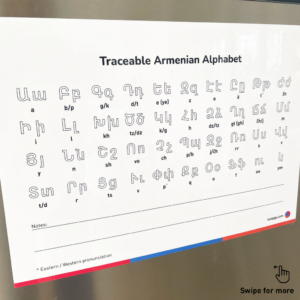

Practice Writing Armenian Fridge Whiteboard & Pen

The ‘Give me everything’ Bundle
Eastern and Western Armenian courses and resources for every level
Browse the selection of Eastern and Western Armenian lessons, masterclasses, Armenian workbooks and Armenian flashcards.
Online Armenian School
Armenian Sentence Structure Masterclass Series – 8 lessons
Armenian Past/Present/Future Masterclass Series – 8 lessons
Armenian Reading and Writing Masterclass Series – 14 lessons
Armenian Reading and Writing Workbook Bundle x 3
Armenian English Alphabet Flashcard Set
Armenian Flashcard Set – Emotions and Feelings PRINTABLE
Practice Writing Armenian Fridge Whiteboard & Pen
The ‘Give me everything’ Bundle
Already fluent in Eastern and Western Armenian?
We are on a mission to help a generation of Armenians learn to speak, read and write. With your help, we can develop more learning resources, improve our learning technology and positively impact more people.
The Armenian Case System Without Tears: A Friendly Guide for Beginners
When someone mentions the seven cases and you feel your heart sink You have been told that Armenian has seven cases. You have seen the tables: nominative, genitive, dative, accusative, ablative, instrumental, locative. You have watched a friend’s eyes glaze over at the word “declension”. And you have privately wondered whether Armenian — with all its beauty, its alphabet, its poetry — is really worth this particular mountain. If this is you, take a breath. The Armenian case system is not the monster it appears to be from the outside, and thousands of learners — including many who now speak the language well — have climbed this particular mountain with less pain than they expected. The first thing to understand is that cases are not a uniquely Armenian difficulty. English has cases too, hiding in plain sight: the difference between “I”, “me”, and “my” is a case system. “He” becomes “him” and “his”; “who” becomes “whom” and “whose”. English speakers use cases effortlessly every day; they simply never needed to think about them. Armenian simply makes the system explicit — and regular — where English left it buried and irregular. The second thing to understand is that the Armenian case system is one of the most regular in the world. English nouns barely decline at all; Armenian nouns decline by patterns that are consistent and predictable. Once you learn the pattern, you can apply it to thousands of words. The mountain, it turns out, is not a mountain of random boulders — it is a staircase, and the steps repeat. What the seven cases actually do Each Armenian case does a job that English handles with word order or prepositions. The nominative is the subject — the person or thing doing the action. The genitive marks possession — the “of” case, the “my” in “my house”. The dative is the recipient — the “to” case, as in “give the book to me”. The accusative is the direct object — the thing the action happens to. The ablative means “from” — from the house, from Yerevan. The instrumental means “with” — with a pen, with a friend. And the locative means “in” or “at” — in the house, at the market. Here is the liberating truth: in modern spoken Eastern Armenian, several of these cases have collapsed together in practice. The dative and accusative look identical in the singular — the word for “to me” and the word for “me” are the same form. The instrumental and locative overlap in everyday use. What looks like a seven-headed monster is really a system of about four distinct forms that you use constantly, plus some refinements you can add later. The seven cases are real — but the learner does not need to master all seven at once, and native speakers themselves blur the boundaries in speech. The regularity is the real gift. Armenian noun endings are added to a consistent stem, and the patterns repeat across thousands of words. The genitive ends in “-i” for the vast majority of nouns — “tun” (house) becomes “tani” (of the house), “kir” (letter) becomes “gri”. The dative/accusative adds “-in” or “-ə” in its own pattern. These endings are the same for almost every noun in the language, which means the learner who learns one noun’s full set of forms has essentially learned them all. Why beginners fear the cases more than they should The fear of cases is mostly inherited. Learners hear the horror stories — “Armenian has seven cases, it takes years” — and they arrive expecting torture. The expectation itself does the damage: learners who believe the system is impossible avoid practising it, and avoidance is the only thing that truly makes it impossible. The learners who succeed are not the ones with special grammar brains. They are the ones who met the cases early, practised them in small doses, and let repetition do the work that fear would not allow. There is also a misunderstanding about accuracy. Beginners often imagine they must produce every case perfectly from the first conversation — and freeze when they cannot. But native speakers do not require perfection; they require communication. The learner who says “tun” instead of “tani” in a moment of pressure will be understood perfectly well. The cases sharpen your language; they do not gatekeep it. Early errors in case endings are not failures — they are the normal, necessary noise of learning. The practical problem is that most learners encounter the cases as abstract tables before they have enough vocabulary to make them meaningful. A table of endings for words you do not know is memorisation; a set of endings for words you use daily is pattern recognition. The sequence matters: build vocabulary first, meet the cases inside real sentences, and let the pattern emerge from the words you already know. How Tun makes the cases accessible At Tun Online Armenian School, students can learn grammar the way it actually functions — inside sentences and contexts, not as abstract tables. The interactive lessons introduce the case endings gradually, with each new form presented through words the learner already knows, and the quizzes provide the repeated, low-pressure practice that makes the patterns automatic. The native-speaker audio models how the cases sound in real speech, where the endings are often lighter and faster than the written forms suggest. The platform’s progression is designed for exactly this journey: vocabulary first, patterns second, perfection later. The result is that learners meet the cases when they are ready for them — with a stock of words to attach them to — rather than as a wall of endings encountered in week one. And because the exercises require producing the forms, not just recognising them, the cases move from the page into the learner’s own speech. Practical strategies for mastering the cases Learn the endings on words you already know. Choose ten nouns from your existing vocabulary — house, bread, water, friend, family, city, book, mother, day, hand […]
Armenian False Friends: Words That Mean Something Else Than You Think
When a familiar word means something completely different You are in Yerevan, trying to navigate a conversation, and you feel confident for once. The word sounds like English. It looks like English. You know exactly what it means. And then the look on the other person’s face tells you that you are wrong. “Bak” — which sounds like “back” — means “yard”. “Magazin” — which sounds like “magazine” — means “shop”. “Konfeta” is not “confetti”; it is sweets. “Mayka” is not “Mike”; it is a t-shirt. The words that trick you are not rare exceptions. Armenian, like every language, has a family of false friends — words that look or sound like English words but mean something entirely different — and they are waiting for confident learners at every turn. False friends are a special kind of trap because they attack your confidence instead of your ignorance. A word you do not know, you look up; a word you think you know, you use as it is — and the error is much more damaging. These words account for some of the most memorable — and embarrassing — mistakes that English-speaking Armenian learners make, and they deserve a place in every learner’s study plan. The good news is that the list of false friends is finite, learnable, and genuinely useful to study. Each one you master is a trap permanently disarmed, and knowing them marks you as a careful learner — the kind of speaker who checks rather than assumes. Where Armenian false friends come from Armenian false friends fall into several families, and knowing their origins helps you remember their meanings. The largest family comes from Russian borrowings that happen to resemble English words. “Magazin” is a Russian word for shop; “bak” comes from the Russian for yard; “konfeta” is Russian for sweets; “marka” is a stamp; “dacha” a holiday house; “stol” a table — each one sounds like something in English and means something else. These words arrived in Armenian through a century of Russian influence, and they remain in daily use, especially in Eastern Armenian. The second family consists of Armenian words that coincidentally resemble English ones. “Hav” sounds like “have” but means “chicken”. “Hur” sounds like “her” but means “fire”. “Tun” sounds like “tune” but means “house” — a word that every learner of the language meets early, and that every English speaker is tempted to pronounce with a “yoo” that is not there. These coincidences are random, but they are also permanent, and each one needs to be pinned down on its own. The third family is the subtle one: words that are genuinely related to English — true cognates — but have drifted in meaning. “Vitamina” means vitamin, but the Armenian usage may be narrower or more specific. “Universitet” means university, but the register of use differs. These are the most dangerous false friends, because the relationship is real — and so is the divergence. The word does not mean what it means in English; it means what Armenian speakers use it to mean. Why false friends matter more than ordinary mistakes Every language learner makes errors, and most errors are harmless. False friends are different because they are invisible. A learner who uses “bak” to mean “back” has no idea they are wrong — the sentence feels right, the confidence is high, and the communication failure is total. The listener hears “yard” where the speaker means “back”, and the conversation derails with no explanation. These are the errors that survive for years, because they are never corrected — the learner never knows they are making them. False friends also poison the cognate strategy. In the previous article in this series, we celebrated the international vocabulary that Armenian shares with English — and it is a genuine shortcut. But the shortcut only works if you can tell the real friends from the false ones. The learner who banks a hundred cognates without learning the exceptions has built a hundred potential traps into their speech. The learner who studies both has the shortcut without the danger. There is a cultural dimension as well. False friend errors often sound comical to native speakers, and — depending on the error — they can cause genuine confusion in important situations. A word used wrongly in a shop, a medical context, or a family argument is not funny; it is a communication failure at exactly the moment communication matters most. The careful study of false friends is not pedantry. It is the practical work of protecting your ability to say what you mean. How Tun helps you master the traps At Tun Online Armenian School, students can learn vocabulary in context — which is the only reliable way to learn false friends. A word learned inside a sentence, with its meaning demonstrated in real usage, is far less likely to be confused with its English lookalike than a word learned from a translation list. The interactive lessons introduce high-frequency words with their actual meanings and usage patterns, and the native-speaker audio anchors the pronunciation so that “tun” is heard as the word for house, not the word for tune. The platform’s quizzes provide the active recall that makes false friends stick: when you are tested on “magazin” and your options include “shop” and “magazine”, the retrieval process itself builds the correct connection. And the spaced-repetition system keeps the tricky words rotating through your memory until the correct meanings are automatic — the point at which the traps are permanently disarmed. Practical strategies for mastering Armenian false friends Build a personal false friends list. Start with the common ones — “magazin” (shop), “bak” (yard), “tun” (house), “konfeta” (sweets), “marka” (stamp), “stol” (table), “dacha” (holiday house), “mayka” (t-shirt) — and add every new one you encounter or hear about. Review the list weekly. The list is finite, and it will shrink in threat as it grows in length. Learn each false friend in a full sentence. A word alone is […]
Armenian Cognates and Borrowed Words: Hidden Shortcuts for English Speakers
When a word sounds like something you already know You are sitting with an Armenian speaker, and they say a word that stops you cold — because it sounds exactly like an English word. “Telefon” — that one is obvious. “Bank” — also clear. Then comes “Komp’yuter”, “Internet”, “Reyting”, “Biznes” — and suddenly you realise that the mysterious new language you have been struggling with shares a whole layer of vocabulary with your own. Armenian, like every living language, has absorbed words from the languages around it for centuries, and in the modern era, English and Russian technical terms have flowed into Armenian as naturally as water into a valley. This shared vocabulary is one of the most underrated resources for learners. Every cognate is a free word — vocabulary you already own, needing only a small pronunciation adjustment. For an English speaker starting Armenian, the hundreds of words Armenian has borrowed from international vocabulary are a hidden head start, scattered through the language like coins on a beach. But the shortcut has a shadow side. Armenian has also borrowed words that look like English words but mean something different, and the languages it has borrowed from — Persian, Arabic, Turkish, Russian, Greek — have left words that only resemble each other. Learning to use the cognates without tripping on the false friends is one of the smartest early investments a learner can make. How Armenian has borrowed — and given — through history The history of Armenian’s borrowed vocabulary is a history of the region itself. From Persian came words for administration and court life; from Arabic, words for science and commerce; from Turkish, words for everyday objects and food; from Greek, religious and scholarly terms; from French, words for fashion and diplomacy; from Russian, the vocabulary of the industrial and Soviet era; and in recent decades, English has supplied technology, business, and pop culture. Each layer of borrowing tells you something about the world Armenian speakers lived in when that word arrived. Armenian has been a lender as well as a borrower. Words like “karpet” travelled from Armenian into other languages, and Armenian merchants and clergy carried their vocabulary along the Silk Road. The word “badarak” for the divine liturgy, “vordan” for rose, even the name “lavash” — the bread that is now UNESCO-recognised — has spread across the region’s cuisines. For the learner, this two-way traffic means that the connections you find are not random; they are the visible traces of centuries of contact. The modern layer is the most useful for beginners. International vocabulary in Armenian — “universitet”, “poliklinika”, “avtobus”, “kino”, “muzyka”, “sport”, “futbol”, “kafe”, “restoran” — is instantly recognisable, and it makes up a surprising portion of everyday modern speech. A learner who consciously mines this layer can build a functional vocabulary of several hundred words in the first weeks — words that are already theirs, needing only the Armenian pronunciation and spelling. Why the shortcuts are underused — and how they fail Most learners never systematically exploit cognates. They approach Armenian as a completely foreign system, memorising every word from zero, when a large subset is already within reach. The cost of this oversight is time — hundreds of hours spent learning words that could have been acquired in minutes. The strategic learner maps the shared vocabulary early, bank the free words, and reserves their memorisation energy for the genuinely unfamiliar core. The shortcuts also fail when they are applied carelessly. The word “bak” in Armenian does not mean “back”; it means “yard”. “Magazin” in Armenian means “shop” — from the Russian — not the English “magazine”. “Drama” exists in both, but “Sensatsiya” carries a Russian flavour. The learner who assumes every familiar-sounding word means what it does in English will be confidently wrong at exactly the moments when confidence matters most. The deeper trap is the borrowed layer’s instability. Armenian has, in recent decades, been actively replacing Russian borrowings with Armenian equivalents — “hatsaran” for “bakery” where the older word was Russian — and the two coexist generationally. A word your grandmother uses may not be the word your Yerevan cousin uses. Learning the cognates is a shortcut, but it must be learned with the awareness that Armenian is a living, changing language with its own preferences. How Tun helps you bank the free words and spot the traps At Tun Online Armenian School, students can learn vocabulary in organised thematic sets that naturally include the international layer — numbers, technology, food, work — with native-speaker audio that teaches the Armenian pronunciation of shared words, which differs more than you would expect from the English original. The interactive quizzes create the retrieval practice that turns recognised words into usable words, and the context-based lessons show how borrowed words behave inside Armenian grammar — how they take Armenian endings, how they shift meaning. The platform’s structured progression is especially valuable for this material: beginners can be pointed toward the accessible international layer early, building confidence and momentum, while the lessons systematically cover the false friends and the semantic shifts that turn shortcuts into traps. The result is a learner who can harvest the free vocabulary without being caught by its exceptions. Practical strategies for exploiting cognates Make a list of the international layer. During your first weeks, write down every Armenian word you encounter that resembles an English word — “avtobus”, “kino”, “sport”, “restoran”, “universitet”, “telefon” — and learn the Armenian spelling and pronunciation of each. You will be surprised how quickly the list grows, and every word on it is a free addition to your vocabulary. Learn the false friends explicitly. The small set of words that look like English but mean something else — “magazin” (shop), “bak” (yard), “drama” (drama, but used in specific contexts), “konfeta” (sweets), “mayka” (t-shirt) — should be studied as a deliberate list, because they are the words that will embarrass you if you assume. Knowing them in advance turns a future embarrassment into a current advantage. […]
