

When you realise verbs are the key to everything
You have learned some Armenian vocabulary. You know the alphabet. You can read simple sentences and understand basic greetings. But when you try to say something that is not in the present tense — something that happened yesterday, or will happen tomorrow, or might happen under certain conditions — you freeze. The verbs, which seemed straightforward when you were learning “es kardum em” (I am reading) and “du kardum es” (you are reading), suddenly branch into forms you have never seen. You reach for “I went” but produce “es gnum ei” (I was going) instead of “es gnatsi” (I went), or you try to say “if I had known” and produce something that your Armenian conversation partner gently corrects. Your meaning is lost or, worse, distorted into something you did not intend.
The Armenian verb system is one of the richest and most expressive features of the language. It makes distinctions that English does not routinely mark — between actions that are completed versus those that are ongoing (the perfective-imperfective aspect), between events the speaker witnessed firsthand versus events they only know about indirectly (the evidential or “witnessed” versus “non-witnessed” distinction in the perfect tenses), between hypothetical situations and certain ones (the subjunctive versus indicative mood). These distinctions, which seem daunting at first, are precisely what give Armenian its precision and emotional range. Learning to use verbs well is the difference between speaking Armenian and speaking Armenian well.
The good news is that Armenian verbs, for all their richness, follow regular patterns that are remarkably consistent once you learn them. There are exceptions, as in any language, but the core system — how verbs are built from roots with predictable prefixes and suffixes, how tense and mood are expressed through consistent modifications to the verb stem — is logical and systematic. The system is learnable by anyone willing to understand its logic rather than trying to memorise every form individually.
What makes Armenian verbs different from English verbs
The Armenian verb system organises time and certainty differently from English. Instead of the twelve tenses that English uses with its complex auxiliary verb combinations, Armenian operates with a smaller number of core tenses combined with aspectual distinctions expressed through changes to the verb stem itself. The present tense (“kardum em” — I read/I am reading), the imperfect (“kardum ei” — I was reading/I used to read), the aorist (“kardatsi” — I read, simple past), the present perfect (“kardalu em” — I have read), the pluperfect (“kardalu ei” — I had read), and the future (“kardalu em linelu” — I will read) cover the temporal range with fewer distinct forms than English requires.
What makes Armenian verbs particularly interesting for English speakers is the system of moods. Armenian has indicative (factual statements), subjunctive (hypothetical, desired, or uncertain actions), conditional (actions dependent on another condition), and imperative (commands) moods, each with its own set of forms and auxiliary verbs. The subjunctive in Armenian is used much more broadly than in English — it appears in “that” clauses after verbs of wanting, in purpose clauses, in clauses expressing doubt, and in many other contexts where English would use a straightforward indicative form. Learning to recognise and produce the subjunctive — “vor kardam” (that I may read), “ete kardai” (if I were to read) — is one of the key milestones in moving from intermediate to advanced Armenian.
Both Eastern and Western Armenian share the same basic verb system, but there are notable differences in how certain forms are used and in the auxiliary verbs that accompany them. Western Armenian has preserved some distinctions — particularly in the perfect tenses — that Eastern Armenian has simplified. The two varieties also use different auxiliary verbs in certain compound tenses: Eastern Armenian uses “em” (am) where Western Armenian uses “em” differently, and the future auxiliary differs between the two. Learners who plan to interact with speakers of both varieties benefit from understanding these differences from the beginning.

Why understanding verb patterns is more useful than memorising forms
Many learners approach Armenian verbs by trying to memorise conjugation tables — the present tense of “linel” (to be), the past tense of “gnal” (to go), and so on, verb by verb. This approach works up to a point, but it quickly becomes unsustainable as your vocabulary grows. There are hundreds of Armenian verbs, each with potentially nine or ten forms across different tenses, moods, and persons. Memorising them all individually is an inefficient use of your mental energy.
The alternative is to understand the patterns that Armenian verbs follow. Most Armenian verbs belong to one of three main conjugation classes in Eastern Armenian or a similar set in Western Armenian. Once you learn the pattern for each class — how the stem changes for the aorist, which suffix marks the subjunctive, how the imperative is formed from the present stem — you can apply that pattern to any new verb you encounter. Learning the rules is more efficient than memorising the products of the rules. As your vocabulary grows from fifty verbs to five hundred, the pattern-based approach becomes exponentially more valuable.
At Tun Online Armenian School, students can learn verb forms in context, seeing how they function in real sentences before mastering the grammatical rules that govern them.
Practical strategies for mastering Armenian verbs
Start with the most frequently used verbs and learn their patterns thoroughly. The verbs “linel” (to be), “unenal” (to have), “gnal” (to go), “gal” (to come), “anel” (to do/to make), “asel” (to say), and “uzenal” (to want) together account for a remarkably large proportion of verb usage in everyday Armenian conversation and text. Mastering these high-frequency verbs in their core tenses — present, past (both imperfect and aorist), perfect, and future — gives you a solid framework for understanding how the entire verb system operates.
Learn verbs in context rather than in isolation. Instead of memorising a flashcard that says “utel = to eat,” memorise a complete sentence that uses the verb naturally: “Es nakhachash utum arajin zhamin” (I eat breakfast at eight o’clock). When you learn the verb as part of a meaningful sentence with specific context, the grammatical forms become associated with meaning, situation, and personal relevance. This association makes recall dramatically faster and more reliable than abstract memorisation.
Practise verb transformations systematically. Take a simple Armenian sentence in the present tense — “Yes kardum em” (I am reading) — and transform it step by step through the tenses: “Yes kardatsi” (I read, completed — aorist), “Yes kardum ei” (I was reading — imperfect), “Yes kardalu em” (I have read — present perfect), “Yes kardalu ei” (I had read — pluperfect), “Yes kardalu em linelu” (I will read — future). This transformation practice, done regularly with different verbs, builds the neural pathways for producing the correct forms automatically in conversation, without stopping to calculate mentally.
Pay close attention to the verb stem. Most Armenian verbs have a recognisable stem that remains consistent across most conjugated forms, with prefixes and suffixes added to express tense, mood, and person. For example, from the stem “kard-” (read), you get “kardum” (present participle), “kardats-” (aorist stem), “kardalu” (future/purpose participle). Learning to identify the stem of any verb you encounter is the single most valuable skill for predicting its conjugated forms. When you meet a new verb, practise identifying its stem and predicting its forms before you look them up.
Finally, be patient and strategic with the subjunctive and conditional moods. These forms appear less frequently in early and intermediate Armenian input but become increasingly important as you move toward advanced proficiency. Start by learning to recognise the subjunctive when you encounter it in reading and listening — identify its characteristic markers before worrying about producing it yourself. Recognition comes first, production follows naturally with exposure and practice. The gap between recognising these forms and producing them confidently closes over time if you maintain consistent engagement with authentic Armenian content.
Ready to start learning Armenian?
Tun Online Armenian School is available online to students in 30+ countries. Students can log in and learn Eastern or Western Armenian at a pace that suits them, and it features lessons, quizzes and interactive games to make learning fun.

Create your free account and start your first lesson now!
✅ Available on mobile
✅ Available on desktop and laptop
✅ Ad-free learning experience
✅ Live practice with other Armenian speakers
✅ Beginner, Intermediate and Advanced levels
✅ Tutor help available
✅ Try before you buy with 4, 8 or 12 lessons free
✅ Cancel any time

Related Articles





-

Armenian Suffixes Masterclass Series – 11 lessons
$85.00Original price was: $85.00.$85.00Current price is: $85.00. -

Online Armenian School
$51.00 – $108.00 / month -

5 x Armenian Lesson Sample
$54.00Original price was: $54.00.$54.00Current price is: $54.00. -

Armenian Sentence Structure Masterclass Series – 8 lessons
$85.00Original price was: $85.00.$85.00Current price is: $85.00. -
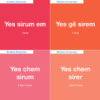
Armenian Past/Present/Future Masterclass Series – 8 lessons
$85.00Original price was: $85.00.$85.00Current price is: $85.00. -

Armenian Reading and Writing Masterclass Series – 14 lessons
$114.00Original price was: $114.00.$114.00Current price is: $114.00. -
Armenian Reading and Writing Workbook Bundle x 3
$54.00Original price was: $54.00.$54.00Current price is: $54.00. -

Armenian English Alphabet Flashcard Set
$25.00Original price was: $25.00.$25.00Current price is: $25.00. -

Armenian Flashcard Set - Animals PRINTABLE
$18.00Original price was: $18.00.$18.00Current price is: $18.00. -

Armenian Flashcard Set - Emotions and Feelings PRINTABLE
$18.00Original price was: $18.00.$18.00Current price is: $18.00.
