
Learn Eastern or Western Armenian Online
Learn Eastern or Western Armenian online
Start learning to speak, read and write in Armenian with easy-to-follow Armenian lessons online and entertaining games, available on demand.

Students in 42 countries and counting…
We have helped more than 25,000 people learn Eastern and Western Armenian – with students in the US, Canada, Australia, Europe, Russia, the Middle East, and even Armenia.

Students in 42 countries and counting…
We have helped more than 25,000 people learn Eastern and Western Armenian – with students in the US, Canada, Australia, Europe, Russia, the Middle East, and even Armenia.


Log in and learn any time
Eastern and Western Armenian lessons are delivered via a webapp, giving you the flexibility to log in and learn whenever it suits you. And all lessons stay online as long as you’re enrolled – so, if you get busy, they’ll be there waiting for you.
Log in and learn
any time
Eastern and Western Armenian lessons are delivered via a webapp, giving you the flexibility to log in and learn whenever it suits you. And all lessons stay online as long as you’re enrolled – so, if you get busy, they’ll be there waiting for you.

Practice with other Armenian speakers
Make new friends, improve your speaking proficiency, build business connections and discover how other Armenians around the world live — via text, voice and video chat.

Practice with other Armenian speakers
Make new friends, improve your speaking proficiency, build business connections and discover how other Armenians around the world live — via text, voice and video chat.


Watch videos, play games and download worksheets
Watch videos, listen to audio, download practice exercises, play learning games and receive tutor support when you need it. We make learning Eastern and Western Armenian interesting, with fun formats to suit every student.
Watch videos, play games and download worksheets
Watch videos, listen to audio, download practice exercises, play learning games and receive tutor support when you need it. We make learning Eastern and Western Armenian interesting, with fun formats to suit every student.

Join at beginner or intermediate Armenian speaking levels
We’ll help you progress from beginner to advanced, with proven learning methodologies that build Eastern and Western Armenian vocabulary, Armenian sentence structure, Armenian grammar, Armenian pronunciation and confidence, so that learning is engaging and long-lasting.

Join at beginner or intermediate Armenian speaking levels
We’ll help you progress from beginner to advanced, with proven learning methodologies that build Eastern and Western Armenian vocabulary, Armenian sentence structure, Armenian grammar, Armenian pronunciation and confidence, so that learning is engaging and long-lasting.


Learn Eastern or Western Armenian dialects
We teach both Eastern and Western Armenian, so you can focus on one dialect, or come to learn the differences between Eastern and Western Armenian, over time.
Learn Eastern or Western Armenian dialects
We teach both Eastern and Western Armenian, so you can focus on one dialect, or come to learn the differences between Eastern and Western Armenian, over time.

Eastern and Western Armenian courses and resources
for every level
Browse the selection of Eastern and Western Armenian lessons, masterclasses, Armenian workbooks and Armenian flashcards.


Online Armenian School

Armenian Sentence Structure Masterclass Series – 8 lessons


Armenian Past/Present/Future Masterclass Series – 8 lessons


Armenian Reading and Writing Masterclass Series – 14 lessons


Armenian Reading and Writing Workbook Bundle x 3

Armenian English Alphabet Flashcard Set


Armenian Flashcard Set – Emotions and Feelings PRINTABLE
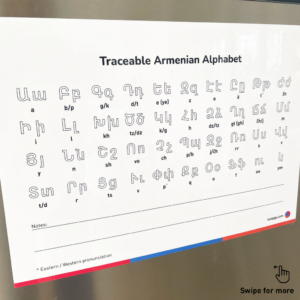

Practice Writing Armenian Fridge Whiteboard & Pen

The ‘Give me everything’ Bundle
Eastern and Western Armenian courses and resources for every level
Browse the selection of Eastern and Western Armenian lessons, masterclasses, Armenian workbooks and Armenian flashcards.
Online Armenian School
Armenian Sentence Structure Masterclass Series – 8 lessons
Armenian Past/Present/Future Masterclass Series – 8 lessons
Armenian Reading and Writing Masterclass Series – 14 lessons
Armenian Reading and Writing Workbook Bundle x 3
Armenian English Alphabet Flashcard Set
Armenian Flashcard Set – Emotions and Feelings PRINTABLE
Practice Writing Armenian Fridge Whiteboard & Pen
The ‘Give me everything’ Bundle
Already fluent in Eastern and Western Armenian?
We are on a mission to help a generation of Armenians learn to speak, read and write. With your help, we can develop more learning resources, improve our learning technology and positively impact more people.


Armenian Handwriting: Alphabet, Cursive Letters & Writing Guide
Learn Armenian handwriting with our guide to the handwritten Armenian alphabet. See Armenian letters in print, handwriting and cursive, with tips for writing Armenian. Armenian Handwriting: How to Write the Armenian Alphabet If you’ve learned to recognise the Armenian alphabet on a screen or in a book, you may notice something surprising when you first see Armenian handwriting: the letters can look quite different. Just as handwritten English develops loops, joins and simplified letter shapes, handwritten Armenian has its own natural forms. Some closely resemble printed Armenian script, while others change considerably when written quickly or in cursive. This guide introduces the Armenian handwriting alphabet, explains the difference between printed and handwritten Armenian letters, and offers practical advice for learning to write Armenian naturally. What does Armenian handwriting look like? Modern Armenian is written using its own distinctive writing system, the Armenian script. The Armenian alphabet was developed in the early fifth century and is traditionally attributed to Mesrop Mashtots. Modern Armenian has 39 letters and is written from left to right. When you first learn Armenian, you’ll usually encounter printed forms such as: Ա Բ Գ Դ Ե Զ Է Ը Թ Ժ or their lowercase equivalents: ա բ գ դ ե զ է ը թ ժ But these aren’t necessarily exactly how an Armenian speaker will form each letter when writing a shopping list, taking notes or writing a card. Armenian letters handwritten naturally become more fluid. Strokes can be simplified, curves become more prominent and experienced writers may connect or partially connect letters. This is why learning to recognise both printed Armenian and Armenian alphabet handwriting is useful if you want to become a confident reader and writer. The Armenian Handwriting Alphabet When learning Armenian handwriting, it’s useful to study four forms of each letter together: Printed vs handwritten Armenian Printed Armenian script is highly standardised. The Armenian you see in books, websites and digital interfaces is created using typefaces designed to make individual characters clear and consistent. Handwriting is naturally more variable. A person’s Armenian alphabet handwriting can change according to their education, age, writing speed, region and individual style. The same letter may therefore look slightly different when written by two Armenian speakers. Think about the English lowercase letter a. The printed a commonly seen in typefaces doesn’t necessarily resemble the way someone writes an a with a pen. The same principle applies to Armenian. That’s why learners should focus on recognising the essential shape and strokes of a letter, rather than expecting every handwritten character to look identical. Armenian Cursive Letters As Armenian handwriting becomes faster and more fluid, writers may use forms commonly described as Armenian cursive letters. Cursive doesn’t necessarily mean that every Armenian letter must be joined to the next. Instead, everyday handwriting may use smoother movements, simplified forms and connections that make it possible to write more quickly. When looking at Armenian letters in cursive, you may notice: For learners, this can initially make Armenian cursive harder to read than printed Armenian. The solution is exposure. Once you regularly compare the printed and handwritten versions of the same words, the differences become increasingly familiar. Armenian Alphabet: Handwritten vs Cursive It’s useful to distinguish handwritten Armenian from highly stylised cursive or calligraphy. Everyday Armenian handwriting This is the Armenian someone might use when writing a note, completing a form or working in a notebook. Letters are generally written quickly and for practical communication. Armenian cursive Cursive writing tends to be more fluid, with letters potentially becoming more connected or simplified. Armenian calligraphy Armenian alphabet calligraphy is concerned with the artistic presentation of Armenian lettering. Letters may be deliberately embellished, elongated or constructed using decorative strokes. Calligraphy can be beautiful, but it isn’t necessarily the best model for a beginner learning everyday Armenian handwriting. If your goal is to communicate naturally, learn clear everyday handwriting first. You can explore calligraphy once you’re comfortable forming the letters. How to Learn Armenian Alphabet Handwriting Learning the Armenian alphabet handwritten is much easier when you practise systematically rather than repeatedly copying the entire alphabet. 1. Learn a few letters at a time Start with a small group of Armenian letters. Look at the printed uppercase and lowercase versions alongside authentic handwritten examples. Practise each one slowly before attempting to write it naturally. 2. Pay attention to stroke direction Don’t just look at the finished character. Watch how the Armenian letter is formed: where the pen begins, which direction it moves and when it leaves the page. Animated stroke-order examples can be particularly useful here. 3. Practise lowercase letters first Uppercase Armenian is important, but most of the Armenian written language you’ll encounter consists predominantly of lowercase letters. Spend more of your practice time learning to write lowercase Armenian comfortably. 4. Move from letters to words Once you know a few characters, don’t continue practising them only in isolation. Start writing real Armenian words. Seeing letters beside one another helps you develop natural spacing and prepares you to recognise the same characters in other people’s handwriting. 5. Progress to complete sentences Eventually, practise writing complete Armenian sentences. At this point, your objective should gradually shift from producing a perfectly drawn character to developing clear, comfortable and consistent Armenian handwriting. How to Practise Handwritten Armenian A simple practice routine might look like this: Step 1 — Look Study the printed and handwritten version of a letter. Step 2 — Trace Trace the handwritten letter several times to understand its movement. Step 3 — Copy Write the character yourself while looking at the example. Step 4 — Recall Cover the example and try writing it from memory. Step 5 — Use Write several Armenian words containing the letter. Step 6 — Read Find examples of the same character in authentic handwritten Armenian and practise identifying it. This moves you from recognising a character to actually being able to use it. Eastern and Western Armenian Handwriting Eastern and Western Armenian use the same fundamental Armenian language script, so […]

Armenian Storytelling: Tales, Anecdotes and the Art of a Good Story
When you notice that every Armenian is a storyteller You are at a gathering — a family dinner, a wedding table, a group of friends in a Yerevan café — and the storytelling begins. Someone recounts an incident from their childhood, and the table is captivated: the voice shifts, the hands move, the timing is impeccable. Then someone else adds a detail, and someone else a correction, and before long the story has grown into a shared performance with the whole table participating. You are not just watching conversation. You are watching a culture that has elevated storytelling to an art form — and you are realising that the ability to tell a story in Armenian is one of the most valuable skills you could ever develop. Armenian culture is built on stories. The epic of Sasuntsi Davit, the tales of Hodja Nasreddin told with Armenian flourishes, the family legends passed down through generations, the jokes and anecdotes that every family has in rotation — storytelling is how Armenians preserve memory, teach values, and entertain each other. In a culture where the written record was often impossible, the story was the archive, and the skill of the storyteller was the preservation of the culture itself. For the language learner, this has a practical consequence: the ability to tell a story — even a simple one — is the single most powerful social skill in the language. Armenians will forgive imperfect grammar, but they will remember a good story. The learner who can hold a table’s attention with a tale has crossed a threshold that no vocabulary list can reach. What makes Armenian storytelling structurally distinct Armenian storytelling has its own architecture that differs from English narrative in ways worth learning deliberately. The classic Armenian tale begins with a formula — “Ka-er, che-er…” (there was, there wasn’t) — a playful opening that immediately signals a story is coming, the way “once upon a time” does in English but with more wink in it. The storyteller establishes the scene with unhurried detail: who the characters were, where they lived, what the neighbourhood was like. Patience is a feature, not a flaw; the Armenian story takes its time because the pleasure is in the telling, not the destination. The middle of the story is built on repetition and escalation, features that are also the language learner’s best friends. A good Armenian storyteller will repeat a phrase with growing emphasis, return to a motif, build to a climax in stages. For the learner, this repetition is comprehensible input of the highest order: the same vocabulary and grammar appear again and again, each time with slightly more context, until the structure of the story carries you through even when individual words escape you. The storytelling voice is itself a register with rules. Storytellers use a distinctive vocabulary of time and place — “mi or” (one day), “ayd zhamanak” (at that time), “henc ayn” (right then) — and a set of interjections that punctuate the tale: “Asa?” (guess what?), “Chek harcnum?” (you might ask), the “Vah!” and “Vay!” of reaction, and the climactic “U imatsy mi inch?” (and would you believe…). Learning these connectors gives you the skeleton of a story you can fill with your own words. Why the fear of telling stories holds learners back — and why it should not Many learners avoid storytelling because it seems like an advanced skill, reserved for the fluent. This is a mistake, and it costs them the most rewarding experiences the language offers. The truth is that a simple story told with heart is more welcome at an Armenian table than a perfect paragraph read from a screen. The standards of the genre are not grammatical perfection — they are presence, humour, and honesty. Armenians love a story told badly but with feeling; they can be moved by a tale told in broken Armenian, and they will be. The deeper fear is usually about losing the thread — forgetting a word mid-story, getting tangled in a verb form, freezing in front of expectant faces. But this is exactly where the Armenian storytelling tradition is forgiving. Interruptions are part of the form: the table helps, the table corrects, the table co-authors. The storyteller in Armenian culture is not a solo performer — the story belongs to the group, and the group will carry you. There is also the matter of material. Learners often feel they have nothing to tell — no dramatic history, no epic material. This misses the point entirely. The best Armenian stories are the smallest ones: the anecdote about the taxi driver, the mishap at the market, the funny thing the child said. The register of the Armenian anecdote is exactly the register of everyday language, which means your existing vocabulary is more than enough to begin. What you need is not more words but more practice at stringing them into narrative. How Tun builds storytelling foundations At Tun Online Armenian School, students can build the sentence structures, connectors, and everyday vocabulary that narrative language depends on. The lessons teach grammar in the context of real speech — how to sequence events, how to express cause and effect, how to describe scenes — so that when you sit down to tell a story, the scaffolding is already there. The interactive format gives you practice producing full sentences rather than isolated words, which is precisely the production skill storytelling requires. The platform’s listening resources, recorded by native speakers, model the rhythm and intonation of natural narrative speech. And the live practice features — speaking with other learners and Armenian speakers — provide the low-pressure audience that every storyteller needs to start. At Tun, the goal is not just to teach you Armenian. It is to give you something to say in it. Practical strategies for becoming an Armenian storyteller Learn three stories by heart. Choose one personal anecdote, one classic Armenian tale, and one joke — and learn each in Armenian well enough to […]

Armenian Love Language: Romantic Words and Expressions for Learners
When you want to say more than “I love you” You have reached a point in your Armenian learning where the everyday phrases feel comfortable. You can order food, ask for directions, talk about your family. And then you meet someone — or you want to say something to the person you already love — and you discover that the Armenian language has depths of affection that English can only approximate. “Yes kez sirem” (I love you) is just the beginning. There is a whole landscape of romantic Armenian: the words that describe the feeling of loving, the terms of endearment that fall like gentle rain on Armenian conversations, the expressions of longing and devotion that poets have used for a thousand years. Armenian is a language that wears its heart on its sleeve. The suffix “jan” — attached to names, to kinship terms, to nearly anything you hold dear — is itself a declaration of affection used dozens of times a day. The word “sireli” (beloved, dear) appears in songs, on signs, in everyday speech. The great love poems of Sayat-Nova and Hovhannes Shiraz are woven into the culture’s memory, and even Armenians who never read a book of poetry know the lines of the famous love songs by heart. If you are learning Armenian to connect with a partner, a spouse, or a family that speaks it, the romantic register is where the language becomes personal. It is the difference between speaking Armenian and speaking from the heart in Armenian — and it is absolutely learnable. What makes Armenian romantic language so distinctive The Armenian vocabulary of love is built on a small number of powerful roots that multiply into an astonishing range of words. The root “sir-” gives you “sirem” (I love), “sireli” (beloved), “sirah” (lover), “ser” (love itself), “sirts” (my heart — the most common term of address between lovers and close friends alike). The word “sirts” is everywhere: “Sirts-jan” (my dear heart), “Im sirts” (my heart), the phrases of everyday affection that Armenians use with a naturalness that can startle learners from more reserved cultures. The endearments themselves have a particular flavour. “Jan” is the foundation — attached to names (“Anahit-jan”), to kinship (“mayrik-jan”), to anything tender. Beyond it lie “sireli” (dear), “sirun” (beautiful — used for both people and things), “goghatsik” (sweetheart), “yekhpayr” in some dialects, “im kiank” (my life), “im hokin” (my soul), “im erek” (my evening — a term used by parents for children in some families). The phrase “Im anush” (my sweet) or “anush sig” (sweet love) carries a softness that translations rarely capture. The verbs of loving are equally rich. “Sirel” is the simple verb to love; “handipel” (to meet), “karedzel” (to long for), “mashtel” (to miss), “khotovel” (to worry about someone you love) — each adds a layer to the emotional map. The expression “Yes kez sirem, im sirts” is not one love phrase but two layered together: I love you, my heart. This stacking of affection — noun upon noun, phrase upon phrase — is characteristic of Armenian romantic speech and gives it its distinctive warmth. Why romantic language is harder to learn than it looks Romantic Armenian is a register where precision matters and mistakes are felt. The difference between “sirem kez” and the more formal “kez sirem” is subtle but real in emphasis. The choice between “jan” and “sireli” and “sirts” changes the warmth of a sentence. Learners who rely on translations often sound either too formal or too casual, and the mismatch is noticeable to native speakers — not as an error to correct, but as a distance to feel. There is also the question of cultural context. Armenian expressions of love are shaped by the culture’s history — the songs of longing written in exile, the poems that turned separation into art, the tradition of “ghaributyun” (longing for home and beloved from afar). Words like “karot” (longing) carry an emotional weight that English “missing you” does not approach. To use them well, you need to understand the feeling behind them, not just the dictionary definition. And the vocabulary itself is scattered across registers: the classical poetic words from the great love lyrics, the everyday endearments of family life, the slang of young Yerevan couples. A learner who studies only the poetic register will sound like a 19th-century novel; a learner who studies only the slang will miss the depth. The balanced approach is to build a core of genuine, usable phrases and learn the feelings attached to them. How Tun supports romantic and emotional language At Tun Online Armenian School, students can learn the everyday vocabulary of relationships and feelings in the context of real conversation — meeting someone, introducing a partner, talking about family, expressing care. The interactive lessons teach words and phrases in sentences rather than isolation, so learners understand how the register shifts between formal and intimate speech. The native-speaker audio is especially valuable here, because emotional language lives in intonation: the warmth of “jan” is carried as much by the voice as by the word. The platform’s quizzes and spaced repetition ensure that the high-frequency phrases of affection — the endearments, the expressions of missing and caring — move into long-term memory where they are available when it matters. And because Tun offers both Eastern and Western Armenian, learners can match the romantic register of their own family or partner’s dialect, which differs more in the intimate vocabulary than in any other part of the language. Practical strategies for learning romantic Armenian Start with the phrases you will actually use and practise them aloud until the intonation is right: “Yes kez sirem” (I love you), “Im sirts” (my heart), “Sireli” (dear), the way to say “I miss you” — “Du ets karot em tasnum” or the more idiomatic “Karetsel em kez” — and the everyday “Inchpes es, im sirts?” (how are you, my heart?). Saying these aloud is essential; emotional language that is only ever read stays forever foreign. […]
