
Learn Eastern or Western Armenian Online
Learn Eastern or Western Armenian online
Start learning to speak, read and write in Armenian with easy-to-follow Armenian lessons online and entertaining games, available on demand.

Students in 42 countries and counting…
We have helped more than 25,000 people learn Eastern and Western Armenian – with students in the US, Canada, Australia, Europe, Russia, the Middle East, and even Armenia.

Students in 42 countries and counting…
We have helped more than 25,000 people learn Eastern and Western Armenian – with students in the US, Canada, Australia, Europe, Russia, the Middle East, and even Armenia.


Log in and learn any time
Eastern and Western Armenian lessons are delivered via a webapp, giving you the flexibility to log in and learn whenever it suits you. And all lessons stay online as long as you’re enrolled – so, if you get busy, they’ll be there waiting for you.
Log in and learn
any time
Eastern and Western Armenian lessons are delivered via a webapp, giving you the flexibility to log in and learn whenever it suits you. And all lessons stay online as long as you’re enrolled – so, if you get busy, they’ll be there waiting for you.

Practice with other Armenian speakers
Make new friends, improve your speaking proficiency, build business connections and discover how other Armenians around the world live — via text, voice and video chat.

Practice with other Armenian speakers
Make new friends, improve your speaking proficiency, build business connections and discover how other Armenians around the world live — via text, voice and video chat.


Watch videos, play games and download worksheets
Watch videos, listen to audio, download practice exercises, play learning games and receive tutor support when you need it. We make learning Eastern and Western Armenian interesting, with fun formats to suit every student.
Watch videos, play games and download worksheets
Watch videos, listen to audio, download practice exercises, play learning games and receive tutor support when you need it. We make learning Eastern and Western Armenian interesting, with fun formats to suit every student.

Join at beginner or intermediate Armenian speaking levels
We’ll help you progress from beginner to advanced, with proven learning methodologies that build Eastern and Western Armenian vocabulary, Armenian sentence structure, Armenian grammar, Armenian pronunciation and confidence, so that learning is engaging and long-lasting.

Join at beginner or intermediate Armenian speaking levels
We’ll help you progress from beginner to advanced, with proven learning methodologies that build Eastern and Western Armenian vocabulary, Armenian sentence structure, Armenian grammar, Armenian pronunciation and confidence, so that learning is engaging and long-lasting.


Learn Eastern or Western Armenian dialects
We teach both Eastern and Western Armenian, so you can focus on one dialect, or come to learn the differences between Eastern and Western Armenian, over time.
Learn Eastern or Western Armenian dialects
We teach both Eastern and Western Armenian, so you can focus on one dialect, or come to learn the differences between Eastern and Western Armenian, over time.

Eastern and Western Armenian courses and resources
for every level
Browse the selection of Eastern and Western Armenian lessons, masterclasses, Armenian workbooks and Armenian flashcards.


Online Armenian School


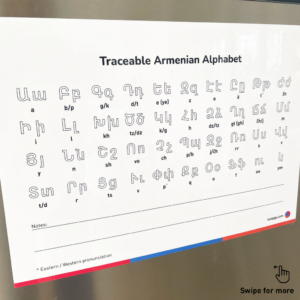


Eastern and Western Armenian courses and resources for every level
Browse the selection of Eastern and Western Armenian lessons, masterclasses, Armenian workbooks and Armenian flashcards.
Online Armenian School
Already fluent in Eastern and Western Armenian?
We are on a mission to help a generation of Armenians learn to speak, read and write. With your help, we can develop more learning resources, improve our learning technology and positively impact more people.


Armenian for Academic Research: Reading Scholarly Texts and Historical Documents
When your research depends on a language you are still learning You are a historian, a linguist, an art historian, a theologian, or a social scientist whose work touches Armenia, the Caucasus, the Armenian diaspora, or any of the fields where Armenian sources are essential. You have the research skills, the analytical framework, the questions that drive your work. But the sources you need — manuscripts, archival documents, scholarly articles, inscriptions, correspondence — are in Armenian, and you are still building the language proficiency to read them with the precision your work demands. The challenge of academic Armenian is different from the challenge of conversational or even literary Armenian. Academic texts use specialised vocabulary, complex sentence structures, and rhetorical conventions that differ from other registers of the language. A historical monograph in Armenian assumes a reader who already knows the political and cultural context of the period under discussion. A linguistic analysis uses terminology from Armenian grammatical tradition that does not always map neatly onto the terms used in English linguistics. The stakes are high because mistranslation in academic work can lead to significant errors in interpretation — a single misunderstood verb form in a medieval manuscript can change the entire meaning of a passage. But the motivation is correspondingly high. When your language learning is driven by the need to access sources that are essential to your work, every word you learn has immediate application and significance. The frustration of slow progress is balanced by the satisfaction of each new text you are able to read independently. The first time you read a primary source in its original Armenian and understand it without reference to a translation — that is a moment that makes every hour of difficult study worthwhile. What makes academic Armenian distinct Academic Armenian operates at a formal register that differs markedly from spoken Armenian. Sentences are longer and more complex, with multiple subordinate clauses connected through participial constructions that English would handle differently. Vocabulary is drawn from a wider range of sources — Classical Armenian or “grabar” for historical and theological texts, Russian-influenced terminology for Soviet-era scholarship (“patmutyan gitutyun” for historical science, “tntesagitutyun” for economics), international academic vocabulary for contemporary research. The passive voice is far more common in academic writing than in conversation, and the rhetorical structures of argumentation — how a thesis is introduced, how evidence is presented, how counterarguments are addressed — follow conventions that may differ from English-language academic norms. Historical documents present additional layers of difficulty. Handwriting styles vary significantly across centuries and regions — the “yerkatagir” (uncial) script of early manuscripts, the “bolorgir” (rounded) hand of the later medieval period, the “notrgir” (cursive notary script) of administrative documents. Abbreviations and shorthand conventions that were standard in certain periods may be unfamiliar to modern readers. The vocabulary of historical institutions, titles like “katholikos” (head of the Armenian Church) or “nakharar” (feudal lord), currencies such as “dram” or “taghvorakan”, weights and measures, and social structures requires specialised knowledge that goes beyond general language proficiency. For researchers working with Armenian manuscripts, there is the added dimension of paleography — the study of historical handwriting. Armenian manuscript hands evolved significantly between the fifth and nineteenth centuries, and reading them requires not just language knowledge but paleographic training to distinguish between similar letter forms across different periods. The rewards of this work, however, are extraordinary. The Matenadaran in Yerevan holds over 17,000 manuscripts in its collection, and Armenian manuscripts preserved texts that were lost in the original, including works of classical Greek philosophy — such as the complete works of Zeno of Citium — that survive only in Armenian translation. Why general language courses rarely prepare you for research Standard Armenian curricula, including most online platforms, are designed for learners with general communication goals. They teach the vocabulary of everyday life, basic grammar, and conversational fluency. This is entirely appropriate for most learners, but it leaves a significant gap for researchers, who need specialised vocabulary, familiarity with formal written registers, and the ability to parse complex, unfamiliar sentence structures at a high level of accuracy. A researcher’s language needs are fundamentally different from a traveller’s or heritage learner’s — precision matters more than speed, and comprehension of complex written text matters more than conversational fluency. At Tun Online Armenian School, students can build the strong foundational skills that academic reading requires. While the platform focuses on general proficiency, the structured curriculum provides the grammatical knowledge, vocabulary range, and reading fluency that form the basis for specialised academic language development. Practical strategies for developing academic Armenian Build your field-specific vocabulary systematically. Compile a glossary of the key terms in your discipline — history, art history, theology, linguistics — in Armenian. For a historian, this might include “taregrutyun” (chronicle), “hishoghutyunner” (memoirs), “arpetakan gitutyun” (historical science). Use scholarly articles, dictionaries like the multi-volume “Haykakan Sovetakan Hanragitaran” (Armenian Soviet Encyclopedia), and consultation with experts to ensure accuracy. Learning the specialised vocabulary of your field transforms incomprehensible texts into challenging-but-readable ones faster than any other single strategy. Read extensively in your field from the beginning of your studies. Even when you understand only a fraction of what you read, the exposure to academic Armenian sentence structures, vocabulary, and conventions accelerates your progress. Use the technique of intensive reading — reading a short passage repeatedly with full attention to every word and structure — combined with extensive reading — reading longer texts for gist, accepting that much will be unclear. Both approaches are necessary, and the combination of both produces noticeably faster progress than either alone. Work with parallel texts when possible. If a source exists in both Armenian and a language you read fluently, use the translation as a key to the original. Read a paragraph in Armenian, then the same paragraph in translation, noting how the Armenian structures map onto the translation. This technique is particularly effective for developing the ability to parse complex Armenian sentences because it trains you to see the relationship between Armenian syntax […]

Breaking Through the Intermediate Plateau in Armenian
When you are not a beginner anymore but fluency still feels far away You have been learning Armenian for a while. You can handle everyday conversations on familiar topics. You understand a significant amount of what you hear and read. You are past the stage where every sentence requires intense concentration. But you are also past the stage where progress feels fast and visible. The beginner-level victories — learning the alphabet, having your first conversation entirely in Armenian, understanding your first Armenian song without reading the translation — are behind you, and the next level of proficiency — real fluency, the ability to discuss complex topics like Armenian history or politics, to understand fast native speech without strain, to express nuanced feelings that go beyond “yes,” “no,” and “thank you” — still seems frustratingly distant. This is the intermediate plateau, and it is the stage where most language learners either break through to advanced proficiency or stop making progress entirely. The plateau is not a sign that you have stopped learning. It is a sign that the kind of learning happening now is qualitatively different from the learning that happened in the beginner phase. Instead of acquiring entirely new structures, you are refining and automatising what you already know. The progress is real — measurable in processing speed, in the length of sentences you can produce, in the range of topics you can discuss — but it is less visible to you, and it is this lack of visible progress that causes many learners to lose momentum and stop. For Armenian learners specifically, the intermediate plateau can feel particularly frustrating because the gap between intermediate and advanced proficiency is genuinely significant. The vocabulary breadth needed to read a newspaper article comfortably, the grammatical precision to use verb aspects correctly in rapid speech, the speed of comprehension demanded by a group of native Armenian speakers talking over each other at a family dinner — these are all substantial jumps from the intermediate level. But the plateau is survivable, and the strategies for pushing through it are well understood and proven effective. What actually happens during the plateau During the intermediate phase, your brain is doing two things at once. First, it is strengthening the neural pathways for the language you already know — making retrieval faster, reducing the cognitive load of production, moving vocabulary from conscious recall to automatic recognition. Second, it is building the capacity for more complex language processing — understanding longer sentences with multiple subordinate clauses, following speech at natural speed without lag, producing more nuanced expressions that convey tone and attitude as well as information. Both of these processes are cognitively demanding, and neither produces the visible, rapid progress of the beginner phase where every new word was a milestone. The plateau can last for months or even years, depending on how much Armenian input you get and how intentionally you practise. But the research on second language acquisition is unequivocal: learners who maintain consistent engagement during the plateau do break through to advanced proficiency. The plateau is not a permanent state — it is a transitional phase that requires patience, strategic adjustment, and continued effort. Most learners who give up do so not because the plateau is insurmountable but because they misinterpret the slowdown in visible progress as a sign that they have stopped improving. What makes the plateau harder for Armenian than for some more widely studied languages is the relative scarcity of intermediate-level graded content. For Spanish or French learners, there is an endless supply of graded readers, intermediate podcasts, and content specifically designed for the B1-B2 level. For Armenian, learners often have to jump from beginner materials designed for children or absolute beginners straight into native-speaker content that is significantly above their level. This gap in available resources requires more creativity and self-direction but does not make the plateau impossible to cross. Why the strategies that got you to intermediate will not get you past it Beginners progress by accumulating new vocabulary and grammar — learning the individual pieces of the language in a deliberate, effortful way. Intermediate learners progress by connecting those pieces into fluent, automatic systems that no longer require conscious attention. The study habits that served you well in the beginner phase — vocabulary flashcards, grammar drills, short reading passages with comprehension questions — may not produce the same results now. What you need instead is massive exposure to comprehensible input at or slightly above your current level, combined with deliberate practice in producing the language under real communicative pressure. At Tun Online Armenian School, intermediate learners can continue to build their skills through progressive lessons that introduce more complex language in a structured, supportive environment that bridges the gap between textbook Armenian and the real language of native speakers. Practical strategies for breaking through the plateau Increase your input volume dramatically. The single most important factor in moving from intermediate to advanced proficiency is the sheer quantity of Armenian you consume. Aim for at least thirty minutes of active listening or reading per day — focused, undistracted time where you are processing Armenian. Supplement with passive exposure — Armenian music, Armenian radio, Armenian podcasts playing while you commute, cook, or clean. The more Armenian your brain processes, the faster the neural pathways will strengthen and the more automatic your comprehension will become. Shift from study to engagement. Instead of “studying Armenian” as a subject, start “doing things in Armenian.” Read Armenian news articles on topics that genuinely interest you — if you love football, read Armenian sports coverage; if you follow technology, read Armenian tech blogs. Listen to Armenian podcasts about subjects you would naturally listen to in English. Watch Armenian YouTube content about your hobbies. When the language becomes a tool for accessing content you actually care about, the effort of comprehension decreases dramatically and the amount of input you can sustain increases proportionally. Focus on output. Intermediate learners almost always understand significantly more than they can […]

Armenian Numbers, Dates and Time: Practical Skills for Everyday Use
When the simplest things turn out to be the most essential You can discuss complex topics in Armenian — history, culture, identity — with reasonable fluency. But when someone asks you what time the meeting is, or how much that basket of dried fruit costs at the Yerevan market, or when your birthday falls, you hesitate. Numbers, dates, and time expressions seem like they should be the simplest part of a language, but they are often where learners get stuck. The mental translation required to convert Armenian numbers into meaningful quantities takes a split second longer than it should, and in conversation, that split second is all it takes to disrupt the flow. You miss the price while you are still processing “eresun” (thirty), and the vendor has already moved on to the next item. Armenian numbers are logical and consistent, but they require dedicated practice because they do not map directly onto English in all contexts. The structure of numbers above ten follows its own patterns — “tasnmek” for eleven, “tasnerku” for twelve, but then “tasnekmeks” and “tasnyots” for certain compound forms. The way Armenians express time — the use of the 24-hour clock in formal contexts, the particular prepositions “in” and “at” that do not always translate directly — differs from English conventions. The Armenian calendar has its own month names, and in both Eastern and Western Armenian, there are multiple ways to express dates depending on whether you are using the civil calendar, the traditional Armenian calendar, or one of the historical calendars still encountered in genealogical and church records. Mastering numbers, dates, and time is one of those unglamorous language skills that has an outsized impact on functional fluency. Once you can handle numbers without conscious effort, a huge proportion of daily situations become accessible — shopping at the market where prices are shouted across stalls, scheduling a doctor’s appointment over the phone, confirming bus departure times at the station, telling someone your address when they ask where you live. The confidence that comes from handling these basic transactions smoothly carries over into every other domain of language use. What makes Armenian number and time vocabulary distinct Armenian numbers from one to ten — “mek” (one), “yerku” (two), “yerek” (three), “chors” (four), “hing” (five), “vets” (six), “yot” (seven), “ut” (eight), “inn” (nine), “tas” (ten) — are the building blocks of the entire numeric system. Numbers from eleven to nineteen follow a pattern similar to English: “tasnmek” (ten-one, eleven), “tasnerku” (ten-two, twelve), and so on up to “tasninner” (nineteen). Tens — “ksan” (twenty), “eresun” (thirty), “karrasun” (forty), “hisun” (fifty), “vatsun” (sixty), “yotanasun” (seventy), “utanasun” (eighty), “innsun” (ninety) — follow regular patterns that combine with units to form compound numbers like “eresunhing” (thirty-five) or “vatsunerku” (sixty-two). The logic is transparent once you learn the building blocks. The calendar presents a choice point for learners. Eastern Armenian uses month names derived from Russian or international sources — “Hunvar, Petrvari, Mart, Aprel, Mayis, Hunis, Hulis, Avgust, Sentyaber, Hoktember, Noyember, Dektyaber” — while Western Armenian uses month names closer to the classical Armenian tradition — “Yunvar, Petrvari, Mart, April, Mayis, Hunis, Yulis, Avgosdos, Septemper, Hoktemper, Novemper, Tekemper.” Days of the week in Eastern Armenian are “Yerkushabti, Yerekshabti, Choreqshabti, Hingshabti, Urbat, Shabat, Kiraki” — literally “second-day, third-day, fourth-day, fifth-day, Friday, Saturday, Sunday.” In Western Armenian, the pattern shifts slightly. Both systems are equally valid, and your choice depends on which variety of Armenian you are studying. Time expressions in Armenian use specific prepositions and word orders that differ from English. “Zham@” (the hour) is followed by a number — “zham@ yotn e” (it is seven o’clock). The preposition “in” for time is expressed by “…” More specifically, “at” a time is often expressed using the case system: “yot-in zhamin” (at seven o’clock). “Zhamy tasnin e” (it is ten o’clock), but “kisvi tasnin” (half past ten, literally “half of ten”). The 24-hour clock is standard in formal contexts in Armenia — “zh@ 15:00-i-n” (at 15:00) rather than “at 3:00 PM” — though casual conversation uses the 12-hour system with context clues like “arev@ nstum e” (the sun is setting) to indicate evening. Why number fluency requires separate practice Number processing in a second language is neurologically distinct from other types of language processing. Research in bilingual cognition consistently shows that multilingual people often perform arithmetic in the language they learned it in, and that number comprehension in a second language remains slower than in a first language even when overall proficiency is high. This is not a failure of your language ability — it is a structural feature of how the brain processes numerical information. It means that number fluency requires targeted practice, not because numbers are grammatically complex, but because the brain processes them through different pathways than other language content. The solution is massive, varied exposure to Armenian numbers in context. Reading prices at an Armenian grocery store, telling the time aloud in Armenian throughout your day, counting inventory, reciting phone numbers and addresses — each context reinforces the same numerical vocabulary in slightly different ways, building the automaticity that allows you to understand and produce numbers without mental translation. Regular practice with numbers in real or simulated contexts produces faster improvement than any amount of abstract study of number tables. At Tun Online Armenian School, students can practise numbers, dates, and time expressions within the interactive lessons, building the automaticity that makes these basic skills feel natural. Practical strategies for mastering numbers and time Practise counting in Armenian during low-cognitive-load moments. Count your steps while walking to the bus — “mek, yerku, yerek, chors…” — the items in your shopping cart at the supermarket, the seconds it takes for your coffee to brew in the morning. Using numbers in low-pressure, habitual contexts builds the neural automaticity that makes them accessible when you need them in real conversation. The goal is to reach the point where “vets-hisun” (six-fifty) registers as a price without your brain needing a detour through English. […]
